
More than a decade ago, shortly after I started birding, a friend gave me an incredible cassette tape by Richard Walton and Robert Lawson titled Birding By Ear. This was my first introduction to a world that has fascinated me ever since. Learning to recognize birds by their songs and calls, every sound becomes a clue to the species around us, their activity and ecology. Soon many of these voices become familiar, and then magical. Just listening to a recording can transport us to a different landscape and season.
Like any new language, birding by ear is a skill that takes lots of practice. Fortunately, there are many ways to get started. Often, local birders are very knowledgeable about songs and calls. Many of them are happy to share their knowledge. Walton and Lawson’s Birding By Ear CDs (now many years out of print) are still excellent if you can find them.
Merlin Sound ID—with some caveats
More recent tools such as the Cornell Lab of Ornithology’s Merlin Sound ID can be very helpful, too. This app provides a library of common songs and calls for the bird species in the region you select. You can also make recordings of the birds you’re hearing and get suggested identifications. This can be a very powerful tool, but it can also backfire… Frequently the app makes identification errors, and it’s no substitute for learning the songs and calls yourself! Always treat Merlin identifications as possible suggestions, not the final word!
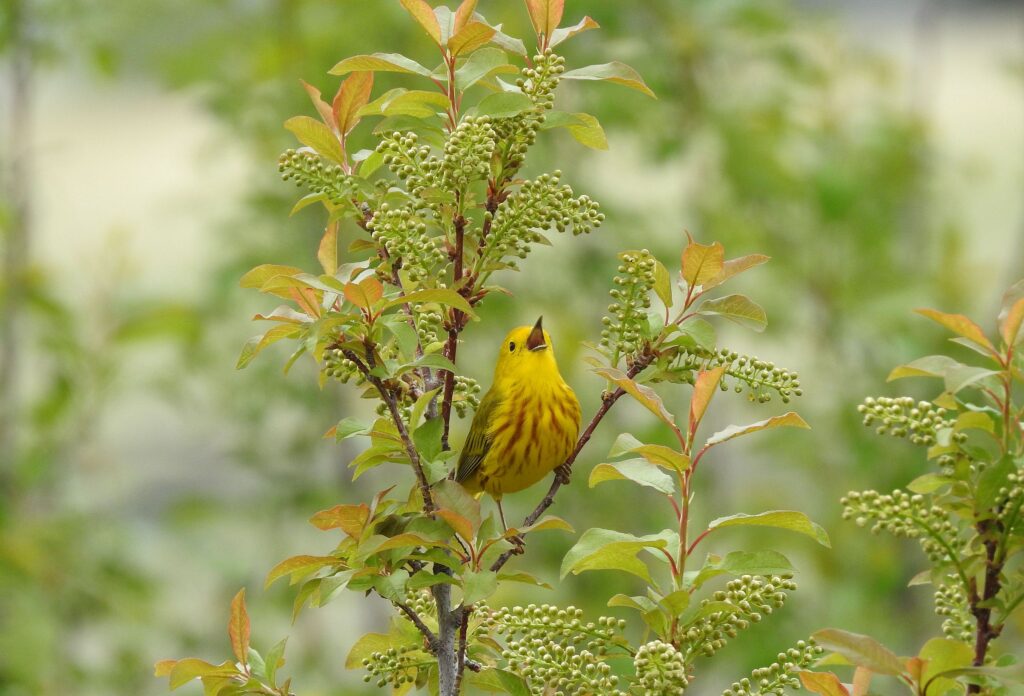
If Merlin tells you it’s hearing a northern yellow warbler (Setophaga aestiva), for example, it’s up to you to confirm the identification. Listen to recordings of several northern yellow warbler songs: how are they similar or different from what you’re hearing? Is that species likely during this time of year at your location? Can you rule out similar-sounding songs, like that of the chestnut-sided warbler (Setophaga pensylvanica)? What else might sound similar? With patience, can you see the bird and confirm it visually? Or ask another local birder for their opinion? Patience, curiosity, and repetition is key. It won’t be possible to identify every mystery sound, but soon many of the local birds will become familiar to you.
Practice birding by ear with Wild With Nature
My podcast provides another great resource to practice birding by ear. Many of my episodes are place-based portraits that transport you to the sounds and ecological happenings of diverse places and seasons across North America, from Montana and Nebraska, USA to Oaxaca, Mexico. Exposure and practice is key… This isn’t an audio guide like Walton and Lawson’s Birding By Ear, but listening to these stories will help you practice and reinforce what you’ve learned through other resources. And as I write this in October 2026, I have several new place-based episodes in the works! Here’s a partial list of these stories, organized by region and habitat, along with some of the birds you can hear in each one. (I list the birds by English common name in the order they appear in each episode.)
Note: you’ll hear all of the bird sounds in these podcasts best if you listen with headphones!
– Shane
Montana, USA
Birds in the Wheat: Great Plains, agricultural and wetland habitats, summer
Featuring Horned Lark, Red-winged Blackbird, Lark Bunting, Franklin’s Gull, Black-necked Stilt
How Not to Find Black-billed Cuckoos: Great Plains, badlands and riparian habitats, summer
Featuring Rock Wren, Grasshopper Sparrow, Northern House Wren, Eastern Kingbird, Gray Catbird, Western Wood-pewee, Least Flycatcher, Common Yellowthroat, Red-naped Sapsucker, Black-headed Grosbeak
The Silence Before the Cuckoo’s Song: Great Plains, riparian habitats, summer
Featuring Black-billed Cuckoo, Black-headed Grosbeak, Great Horned Owl, Orchard Oriole, Northern House Wren, Common Nighthawk, American Kestrel, Brown Thrasher
Nature at Lake Helena: intermountain valleys, wetland and mudflat habitats, spring
Featuring Trumpeter Swan, Western Marsh Wren [split in 2026 from Eastern Marsh Wren], Sora, Red-winged Blackbird, Sandhill Crane, American Avocet, Ring-billed Gull, Black-bellied Plover, Least Sandpiper, Semipalmated Plover, Brown-headed Cowbird, Common Yellowthroat, Virginia Rail
Of Bitterns and Bank Swallows: intermountain valleys, wetland habitats, summer
Featuring Wilson’s Snipe, American Bittern, Common Yellowthroat, Western Marsh Wren [split in 2026 from Eastern Marsh Wren], Bank Swallow, Common Nighthawk, Marbled Godwit, Virginia Rail
Sandhill Cranes and Baird’s Sandpipers: intermountain valleys, wetland and mudflat habitats, fall
Featuring Sandhill Crane, Red-winged Blackbird, Baird’s Sandpiper, Greater Yellowlegs, Canada Goose, Ring-billed Gull, Caspian Tern
Immersed in the Spring Forest: intermountain valleys, riparian habitats, spring
Featuring Pileated Woodpecker, Tree Swallow, Song Sparrow, Red-naped Sapsucker, Northern Waterthrush, Gray Catbird
Learning from Starlings: intermountain valleys, urban habitats, spring
Featuring European Starling and this tricky species’ mimicry of a variety of other birds
Among the Redcedars: Rocky Mountains, moist conifer forest, spring
Featuring Townsend’s Warbler, Varied Thrush, Western Tanager, Pacific Wren
Nebraska, USA
A Portrait of Nature Along the Niobrara River: Great Plains, riparian habitats, fall
Featuring Eastern Screech-owl, Great Horned Owl
Oaxaca, Mexico
A Flight of Amazons: Pacific lowlands, urban and agricultural habitats, summer
Featuring Great-tailed Grackle, Yellow-winged Cacique, Russet-naped Wren, Tropical Kingbird, Blue-black Grassquit, Lilac-crowned Amazon, Yellow-green Vireo, Northern Bobwhite
Mystery of the Twilight: Pacific foothills, agricultural and semi-evergreen tropical forest habitats, winter
Featuring Thicket Tinamou, Collared Forest-falcon, Middle American Screech-owl, Mottled Owl, Common Pauraque
An Explosion of Voices: Pacific foothills, semi-evergreen tropical forest, spring
Featuring Great-tailed Grackle, Spotted Sandpiper, Great Kiskadee, Rufous-backed Robin, Mexican Motmot [previously known as Russet-crowned Motmot before a split in 2026], Happy Wren, Cinnamon-bellied Saltator, Social Flycatcher, Black-headed Saltator
From Alfalfa to Oak Forest: interior valleys, agricultural and oak forest habitats, summer
Featuring Chihuahuan Meadowlark, Dwarf Vireo, Cinnamon-rumped Seedeater, Mourning Dove, Common Raven, Pileated Flycatcher, Black-chinned Sparrow, White-throated Towhee, White-winged Dove, Bewick’s Wren, Blue Mockingbird, Oaxaca Sparrow, Woodhouse’s Scrub-jay, Spotted Towhee, Chestnut-sided Shrike-vireo, White-eared Hummingbird, Rivoli’s Hummingbird, Mexican Violetear, Violet-crowned Hummingbird, Bumblebee Hummingbird
(coming very soon, scheduled for publication November 1, 2026!)