

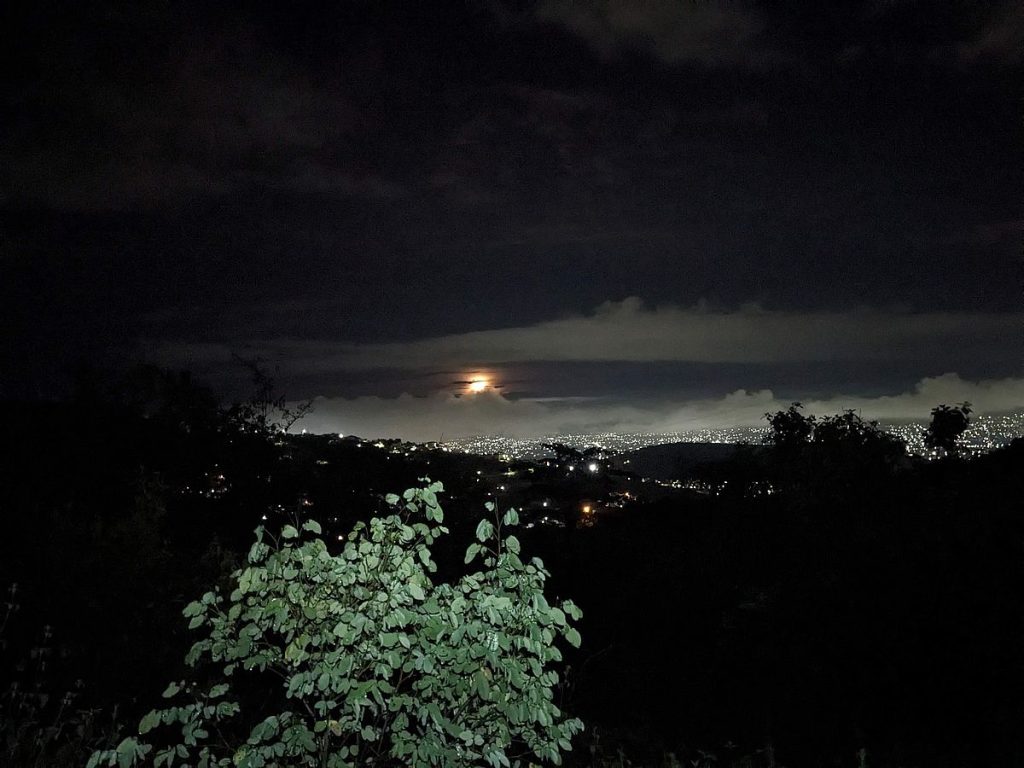
The full moon hangs in the black western sky over the thorny matorral above the city of Oaxaca de Juárez, Mexico. Buff-collared nightjars (Antrostomus ridgwayi) give their stuttering songs from the rocky ground between sleeping, rain-drenched shrubs. A fog bank covers part of the valley, glowing with the city lights below.
The moon slips slowly into the fog. The eastern sky gradually lightens. Higher on the slope, a great horned owl (Bubo virginianus) hoots authoritatively as the dawn chorus begins all around.
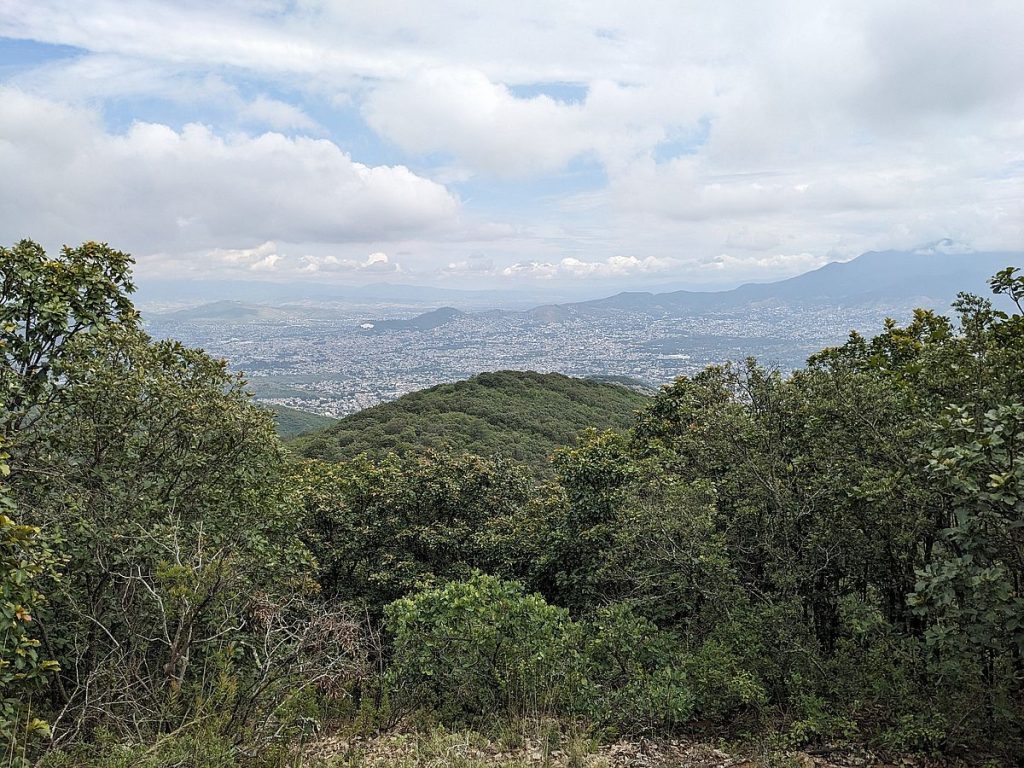
By 10:30 am, the matorral and the stunted oak forest above is almost completely silent. A brutal late-July sun breaks through the clouds. A blue-gray gnatcatcher (Polioptila caerulea) is giving its whining mew call from the oaks, accompanied by a distant chainsaw.
A dry summer
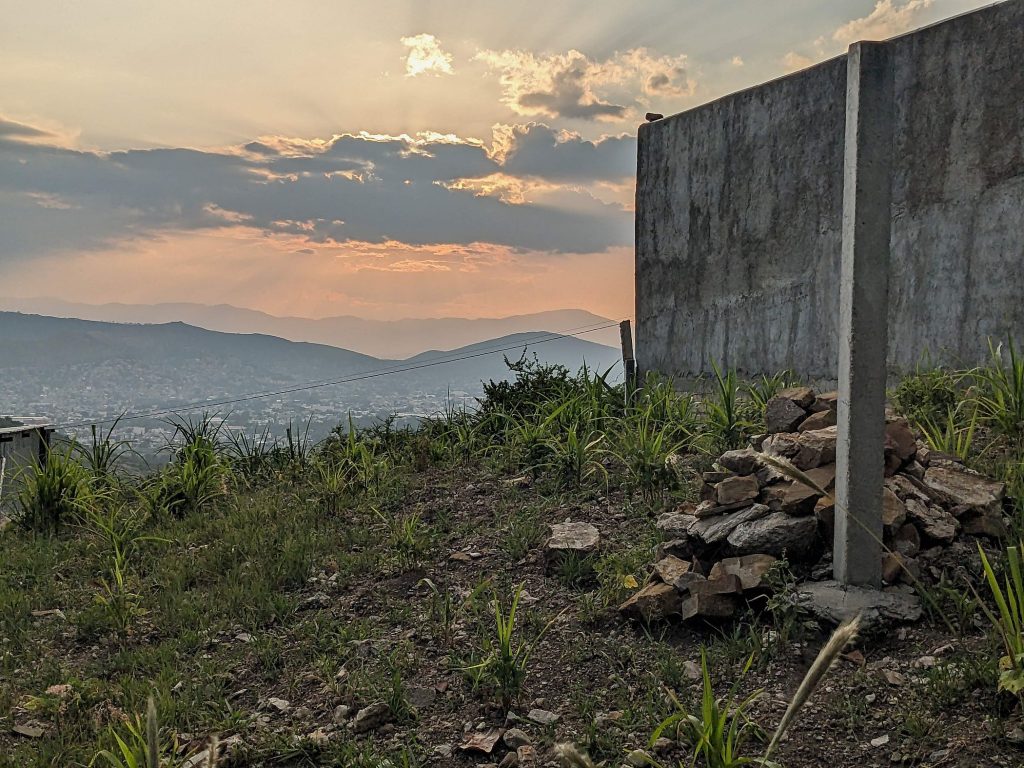
Yesterday’s rain was extremely welcome: this summer’s rainy season has been abnormally dry here so far. At the edge of the city, where houses replace matorral, someone has optimistically planted a small patch of corn in the rocky soil. The corn is sparse and stunted. I’m not convinced that corn would grow well in this spot even in a wet year. But the drought definitely isn’t helping.
I try not to think about the plants in our terreno near the Pacific coast. The small, rocky course of the Río Sal flows right past it; when we’re home, I can haul buckets of water from the river to help the plants through the worst of the dry spells. But when we’re gone, all I can do is keep hoping for rain.
El Niño
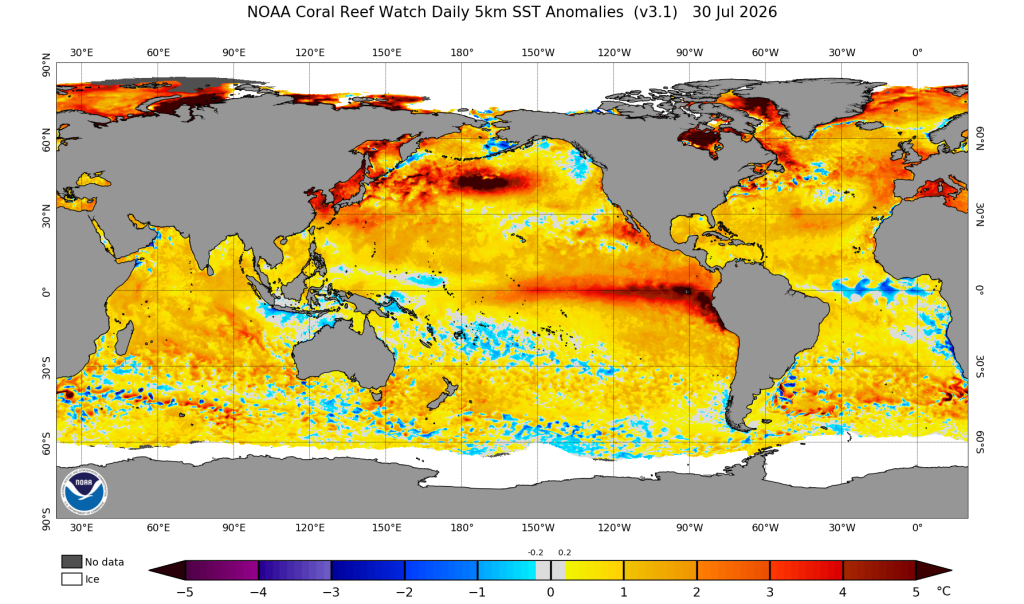
This year’s El Niño pattern keeps intensifying. The surface waters of the eastern equatorial Pacific are hotter than they’ve ever been recorded in July. We seem to be on track for an El Niño event that will break all the records. Biologist and international bird guide Álvaro Jaramillo points out that a large region of the northern Pacific is experiencing a major heat wave, too. The unusually warm, nutrient-poor water causes a drop in phytoplankton productivity, initiating a chain reaction throughout the food web. Fish, whales, and seabirds such as albatrosses and shearwaters must move or face the prospect of starvation.
This June and July, fishers and biologists have observed a sharp rise in numbers of dead seabirds along the Ecuadorian coast—among them sooty shearwaters (Ardenna grisea), blue-footed boobies (Sula nebouxii), and waved albatrosses (Phoebastria irrorata). And the El Niño is forecast to continue strengthening in the upcoming months. In summary, writes Álvaro, “this is not good for marine life.”
Thirsty corn
On Oaxaca’s Pacific coast, the general expectation in El Niño years is drought—coupled with more hurricanes than normal. This year’s dry summer is matching up. I hope we’ll get lucky and avoid the hurricanes. The ocean is warmer than normal here, too, though it’s pretty mild compared to the hotspots farther south and in the northwest Pacific.
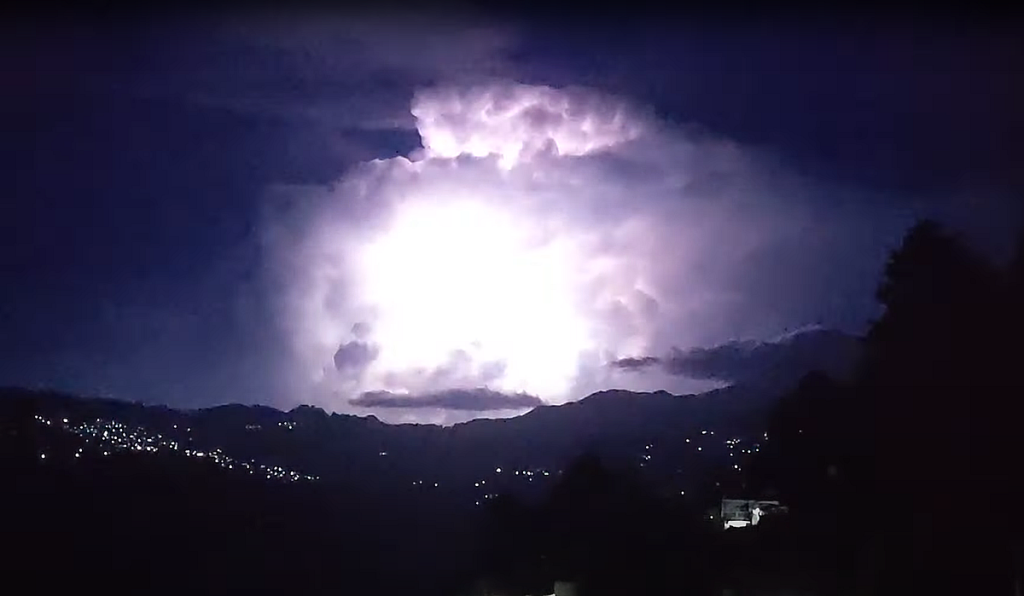
At the beginning of August, we go with our Tío Carlos to visit his home pueblo, Tamazulápam del Espíritu Santo, high in the pine forests of the Sierra Mixe. I assume that here in the mountains it’s surely rained. I’m wrong. Hooded yellowthroats (Geothlypis nelsoni) sing from milpas where the corn is tall but thirsty-looking. In the evening, a far-away thunderstorm lights up the tall peak of the Cerro Zempoaltepetl. But the rains don’t come.
Intense summer
Rebecca Solnit, writing for the Guardian, summarizes the toll a runaway climate is exacting across the earth this summer. 20,000 deaths in Europe from brutal heat waves. 600 homes burned to the ground in and near Spokane, Washington; massive fires across much of Europe and North America. According to the World Meteorological Organization, this July was the hottest on record in Africa, Asia, and North America. Much of Europe is experiencing drought.
When the rains come, they can be just as destructive. Natasha May and Jonathan Watts report that in early July, parts of Bangladesh received well over a foot of rain [over 40 cm of rain] in 24 hours. From Afghanistan to India and Bangladesh, the heavy rains have destroyed homes and even taken lives; in China, this year’s typhoons have triggered the evacuations of hundreds of thousands. And just a few days ago, the collapse of a glacier in the Himalayas caused catastrophic flooding in Nepal and Tibet, leaving hundreds of people dead.
Summer is more intense than it used to be.
Rainy season
It’s more intense where we live on Oaxaca’s coastal plain, too. As a kid in the 1990s in her grandparents’ home near Huatulco, Carito remembers how the months of rainy season brought an abundance of life-giving moisture, cooler temperatures, relief from the brutal spring heat. It would often rain nonstop for a week, at times gentle and at times heavy, but a full week of constant moisture from the sky. Once the rains first began in May or June, I understood, we could expect at least a shower pretty much every afternoon.
But this year, the rains we were all counting on haven’t come. The thunder clouds gather each afternoon over the mountains of the Sierra Sur above us, promising moisture, then move on without a single drop. In three months of “rainy season,” we’ve had maybe 5 days with a soaking rain. The abuelo Teo, who almost never complains, talks frequently about how it’s so unusually hot and dry.
Return to the coast
We’ve been away from home for a week and a half now. It’s time to return to Huatulco. As we drive across Oaxaca’s central valley, Carito gets word that it’s raining on the coast. I try not to get my hopes up.
The pavement is wet as we descend the curves from Pluma Hidalgo to Huatulco, but it’s already drying out. Tomorrow will reveal the answer I’m hoping for and dreading. Have the plants survived?
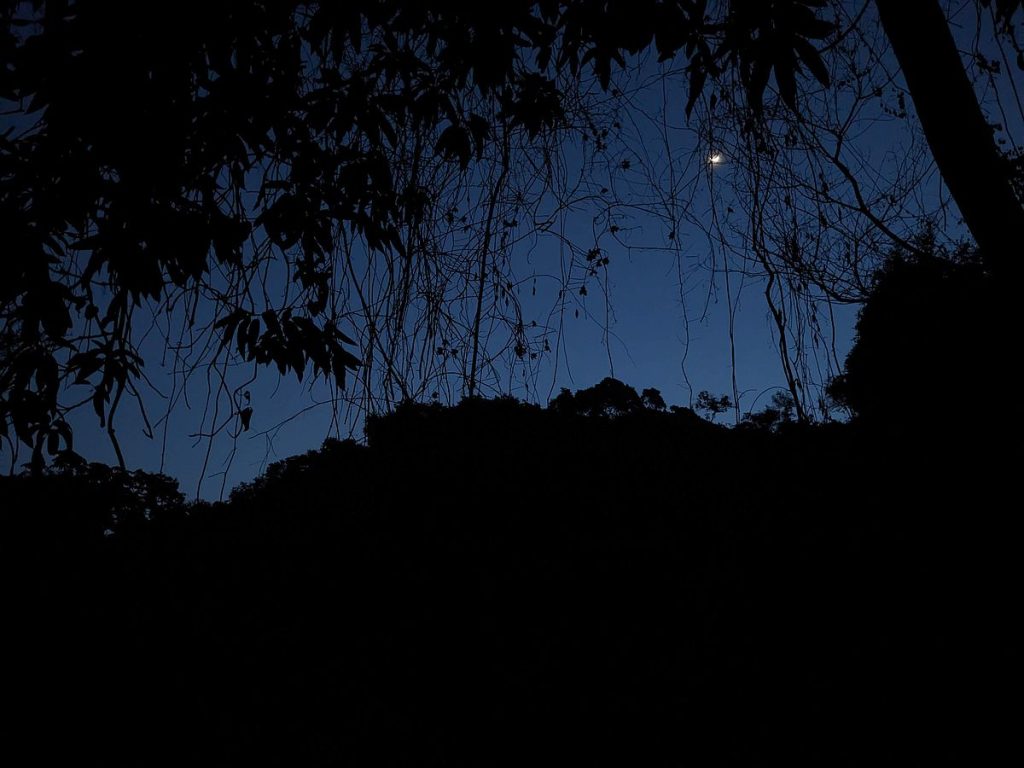
The last sliver of the waning moon hangs in a dark blue sky over the terreno as the stars begin to fade. A collared forest-falcon (Micrastur semitorquatus) sings in the distance. The dawn chorus picks up speed. A couple of northern barred-woodcreepers (Dendrocolaptes sanctithomae) greet the morning with their questioning phrases. A black-headed saltator (Saltator atriceps) blasts out its call, moving to the top of the guarumbo tree (Cecropia obtusifolia), so close that my ears hurt. The sky grows softer, speckled with pastel clouds.
Good news
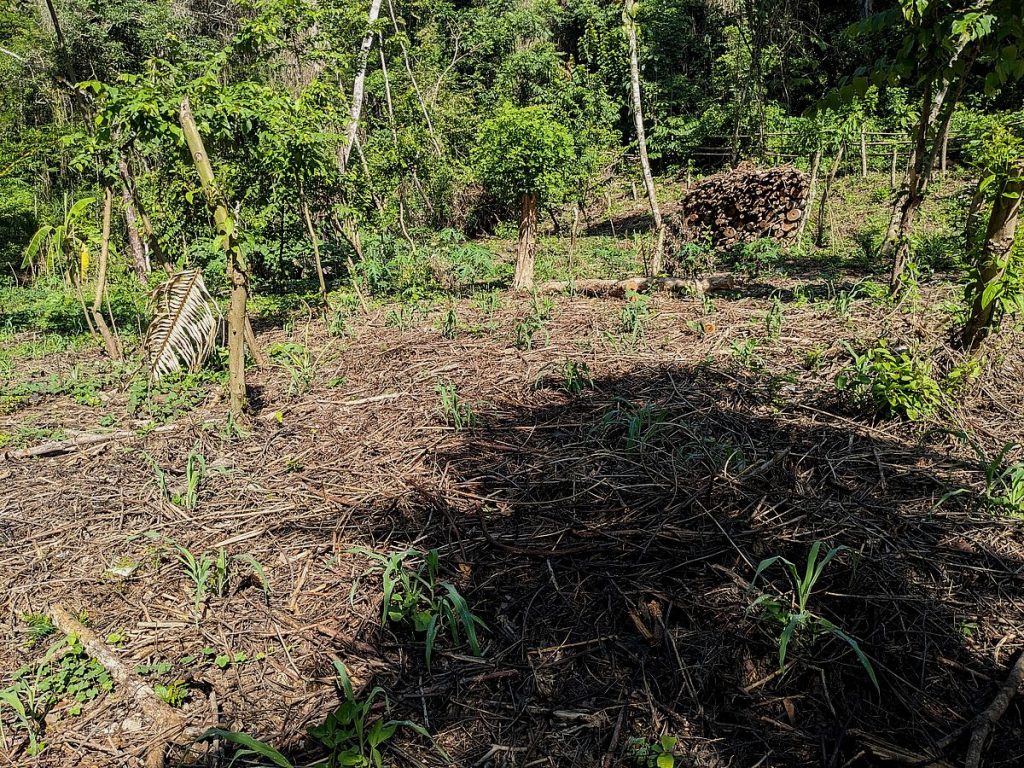
The morning light gives me the best news I could have hoped for. Between the brief rain, the minimally-disturbed soil, and the mulch of leaves and branches that I’ve left in place, almost everything has survived.
The corn I planted before we left is a foot high now. The weeds have grown, too, and I work my way along with the machete, cutting back espina de clavo vines and mala mujer, adding to the mulch layer.
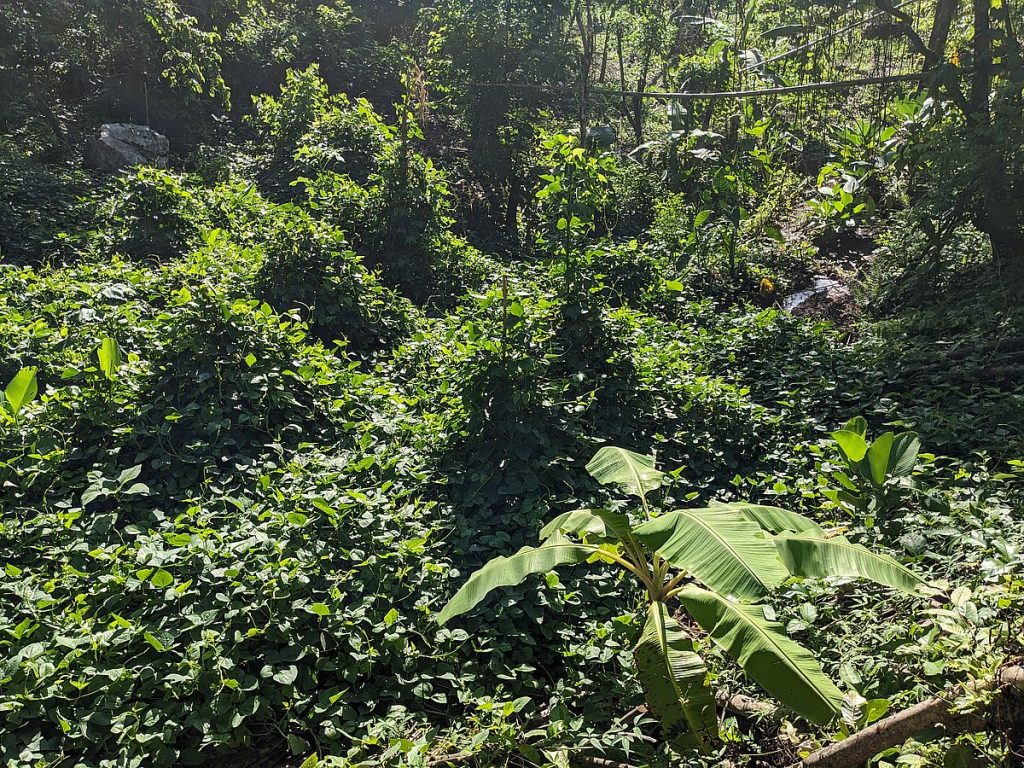
The peanuts are flowering, though I can see that the leafcutter ants have been munching on them. The beans I planted in March along the arroyo have grown into a sprawling green monster, climbing over the hibiscus and okra, engulfing the young lime tree, clambering up the bananas. These beans are so vigorous now that I’m pretty sure they’re safe from leafcutter ants. I chop them back with the machete, uncovering the lime tree.
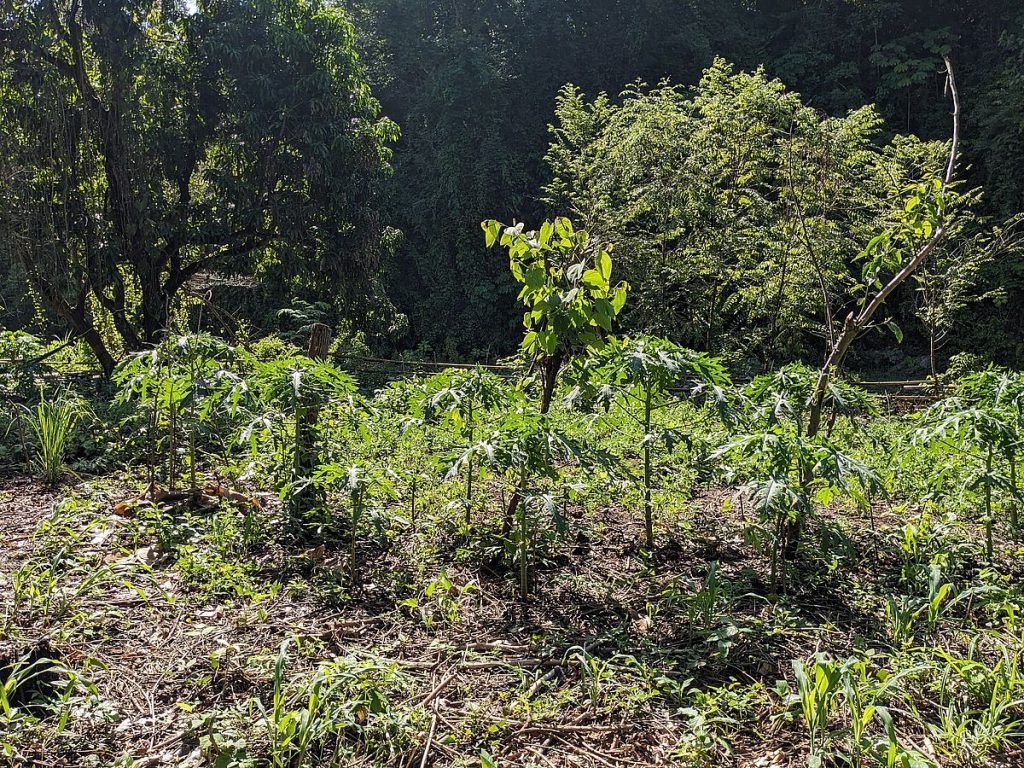
The papayas I started in pots and transplanted out, watering them with a bucket and shading them with branch trimmings, are waist high. The turmeric is lush, the ginger less so. Five breadfruit seedlings I bought in March are looking healthy. The jackfruit, pitahaya, and passionfruit are inching along but surviving. There’s not much to harvest yet, but there are a few things: lemongrass, chepil greens (Crotalaria sp.), mirasol chiles, yardlong beans, okra. Not too bad after a week and a half away.
Sustaining life
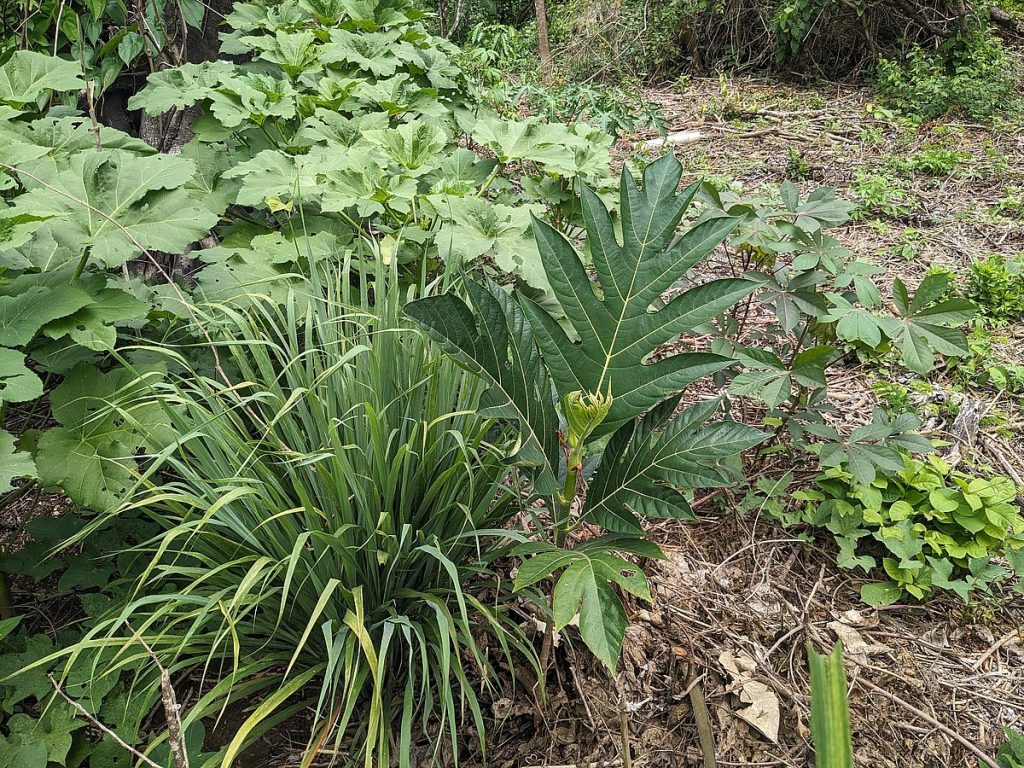
As climate change makes life harsher, I’m thinking a lot about what I can do, together with my local plants and animals, to respond. Here, that looks like planting a lot of different things, annuals and especially perennials, edible leaves, tubers, and seeds. I hope that lots of different plants will mean more resilience. If a drought wipes out the corn, there’s still a good chance that the papaya, nopales, and passionfruit will survive.
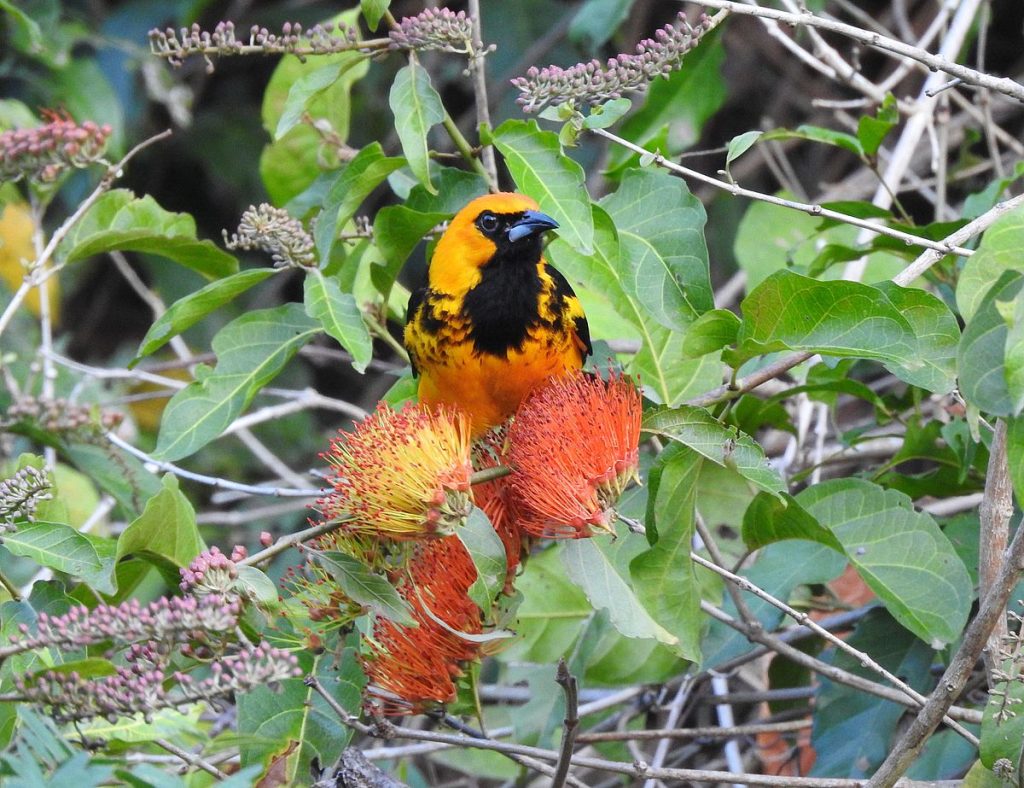
Adapting to climate change looks like keeping the soil covered and protected, chopping down weeds as compost and mulch, sharing seeds and plants with family, friends, and neighbors. Even if our crops fail, hopefully someone else’s will make it through. It looks like planting not just food but also habitat for the animals that have no escape from the wild weather. On my to-do list is more cacahuanano (Gliricidia sepium), a leguminous tree whose flowers are a popular food for orioles and parakeets in January; two species of Combretum vine, whose showy comb-like flower sprays feed pollinating insects and birds from November through March; and the fall-flowering coquito tree (Lafoensia punicifolia), which is popular with various species of hummingbirds.
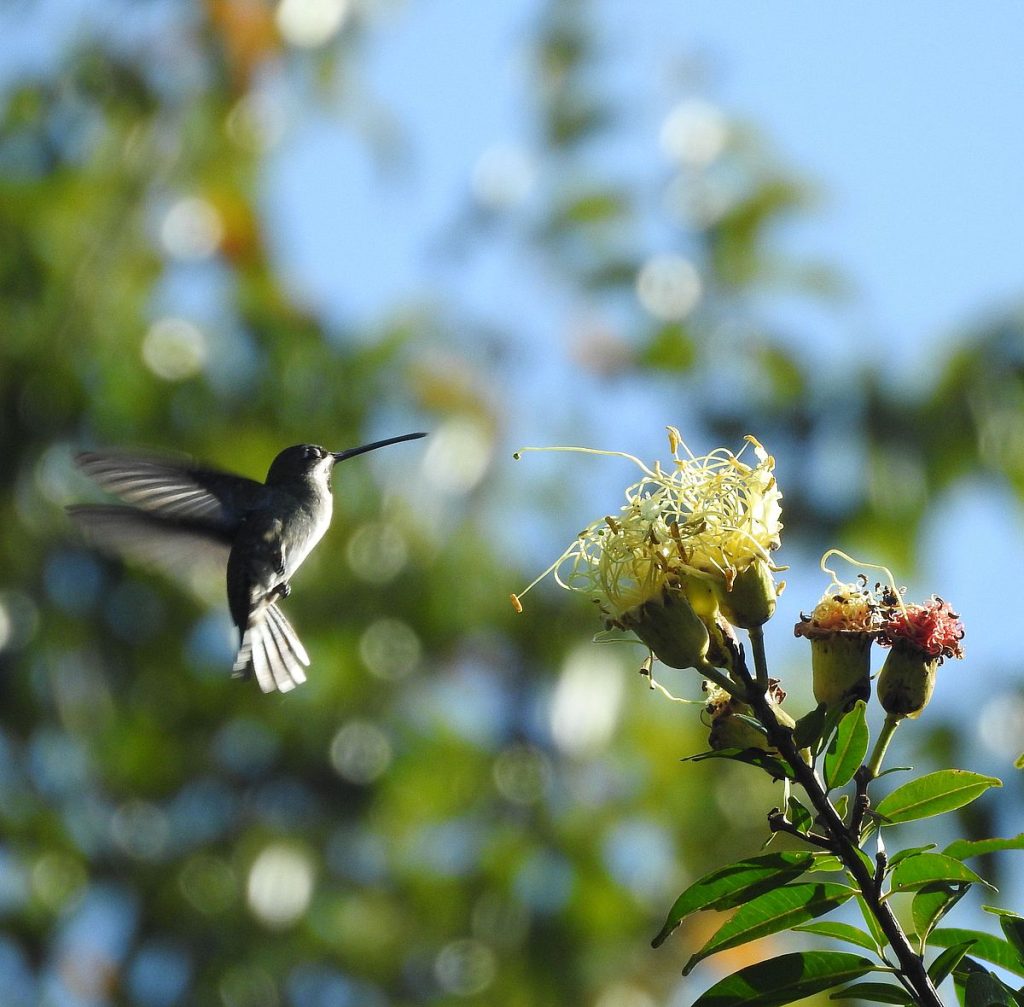
And sometimes, after pouring months of sweat and love and aspirations into this earth, I have no choice but to step away for a week and a half in a drought, and hope. The less help these plants need from me, the better-equipped we’ll be for the unknown of the months ahead.
Thank goodness something survived.
A cup of water in the drought
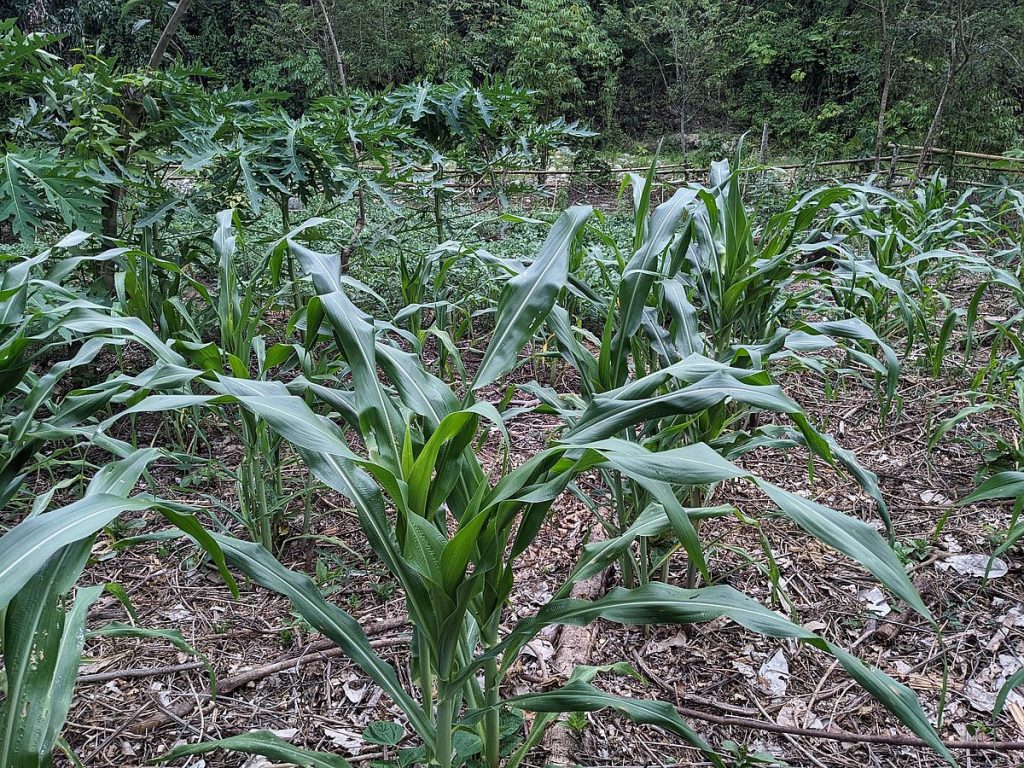
It’s mid August. It’s been bone dry since we returned to Huatulco. The first of the fall migrant birds are arriving. In the last few days I’ve heard the fall’s first least flycatcher (Empidonax minimus), willow flycatcher (E. traillii), Louisiana waterthrush (Parkesia motacilla), and orchard oriole (Icterus spurius).
So far, the plants are still alive. Will it be enough—the intact soil, the mulch, the diverse plantings—to make it through the drought?
I don’t know. There are reports of milpas shriveling and drying up across the region: the central valley, the Oaxacan Mixteca, the coast, Puebla, Guerrero. I spend one afternoon watering the milpa with buckets, a cupful of water for each hopeful cluster of corn and beans. I keep waiting for rain. If we don’t get moisture in the next month or two, we’ll be entering the long dry season already parched. The river is now the lowest I’ve seen it, and I fear it’s just a matter of time before it dries up completely. In the long term, I want to add more organic matter to help retain water in this sandy soil. But for now, I can just dip cupfuls of water, and hope for rain.
Growing in the dark
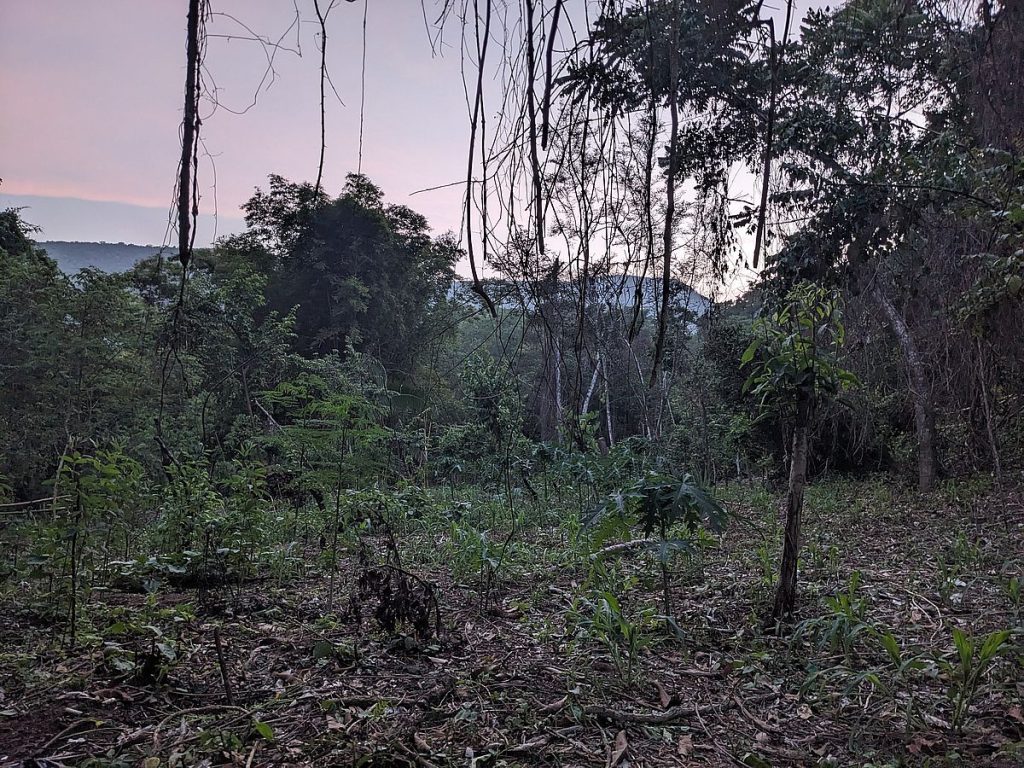
It’s dusk now at the terreno. The hour of the insect chorus. Soon, the trees will darken into silhouettes, and the trill of the Middle American screech-owl (Megascops guatemalae) will carry across the forest. It’s time for me to leave, but the sounds and happenings of this place will stay with me. What will happen next week is uncertain, but this is what’s here now. The bats that flit across the dimming sky; the fireflies Carito used to see so many of when she was a kid. The nocturnal leafcutter ants carrying away pieces of the peanut plants; the emphatic yelps of the mottled owl (Strix virgata). The dew that falls every night, a tiny bit of moisture to help us through the drought. And all of these plant allies, growing in the dark. Growing to sustain us and our neighbors, we hope, come what may with this crazy climate.
Further reading
American Bird Conservancy. (2026, 6 August). Pacific seabird die-offs demonstrate the need for fishery action. https://abcbirds.org/news/pacific-seabird-dieoff-2026/
Badillo, Diego. (2026, 9 August). El Niño 2026–2027: prevén más huracanes en el Pacífico mexicano y sequía en el centro del país. El Economista. https://www.eleconomista.com.mx/politica/nino-2026-2027-preven-huracanes-pacifico-mexicano-sequia-centro-pais-20260809-827329.html
Climate Prediction Center. (2026, 3 August). ENSO: recent evolution, current status and predictions. National Oceanic and Atmospheric Administration. https://www.cpc.ncep.noaa.gov/products/analysis_monitoring/lanina/enso_evolution-status-fcsts-web.pdf
Lu, Donna. (2026, 27 August). What caused the catastrophic flood in Nepal and Tibet – and how does a glacier collapse? The Guardian. https://www.theguardian.com/world/2026/aug/27/what-caused-the-catastrophic-flash-flood-in-nepal-and-tibet-and-how-does-a-glacier-collapse?
Marine Conservation Society. (2026, 8 June). Super El Niño explained: what this could mean for marine life. https://www.mcsuk.org/news/article/super-el-nino-explained-what-this-could-mean-for-marine-life/
May, Natasha & Watts, Jonathan. (2026, 28 July). ‘We have lost everything’: extreme rainfall across Asia brings flash floods and typhoons. https://www.theguardian.com/environment/2026/jul/28/extreme-rainfall-asia-flash-floods-typhoons-climate-change
Servicio Meteorológico Nacional. (n.d.). Estatus del Niño – Oscilación del Sur (ENOS). Impacto de ENOS en México. https://smn.conagua.gob.mx/es/climatologia/diagnostico-climatico/estatus-del-nino
Solnit, Rebecca. (2026, 4 August). We launched a war on nature. Now we are in a climate war zone. The Guardian. https://www.theguardian.com/commentisfree/2026/aug/04/summer-heat-climate-war-zone
Watson, Julie. (2026, 1 July). A marine heat wave caused seabird deaths off California. El Nino could worsen the die-off. Associated Press. https://apnews.com/article/seabirds-marine-heat-wave-deaths-ocean-climate-056b2e8539df2d99d155a95c82ac67cc
World Meteorological Organization. (2026, 12 August). Record-breaking heat and extreme weather continue. https://wmo.int/media/news/record-breaking-heat-and-extreme-weather-continue